Sensor development
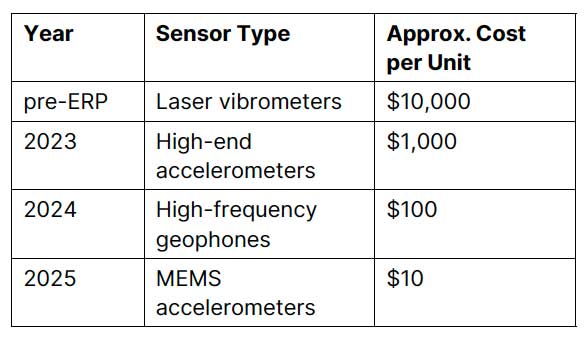
Over the course of three years, we have tested a large variety of vibrational sensors upon their adequacy to record ultrahigh frequency wavefields. We observed an annual 10-fold reduction in price for our preferred sensor type each year, while maintaining required performance. Past sensors included a laser vibrometer ($10,000) and high-end accelerometers (PCB, Bruel&Kjaer, Dytran; around $1000).






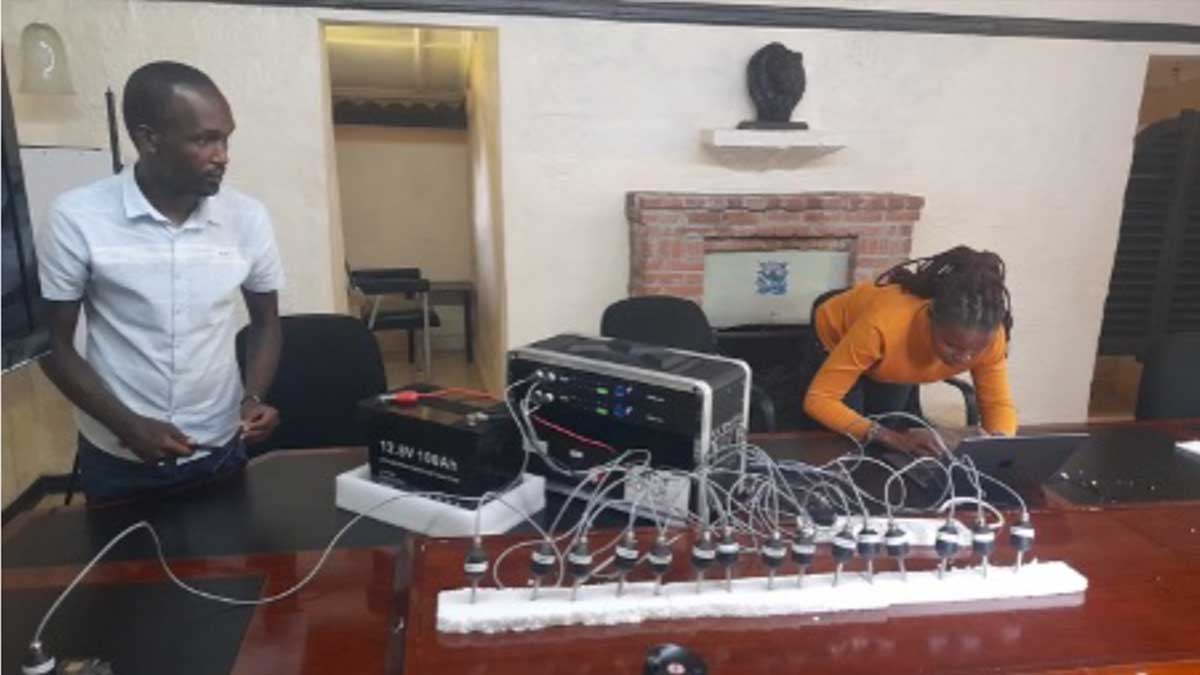
MEMS (~$1-10)
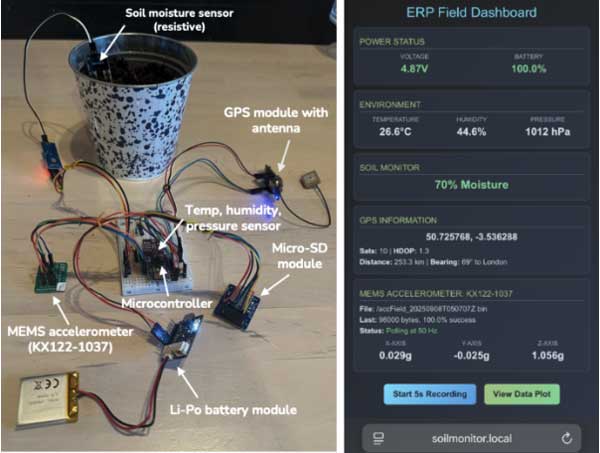
Since 2025, we develop smart, scalable sensing systems for real-time soil and environmental monitoring. Our prototype combines versatile sensors and an intuitive field dashboard to track temperature, humidity, pressure, soil moisture, GPS-based location and timing, and most importantly, energy-efficient vibration measurement via a MEMS accelerometer. Remote connectivity provides instant access to data alongside local storage. Designed for low cost and easy integration, our system enables high-performance soil monitoring at a fraction of the cost of traditional accelerometers, paving the way for large-scale, intelligent environmental monitoring networks
Mobile Phones:
Most common mobile phones possess MEMS sensors (see above) for acceleration detection. We have tested dozens of phones popular in agriculturally relevant regions around the world (Africa, South Asia, Latin. America, North America, Europe) upon their adequacy to record ultrahigh frequency wavefields. This primarily boils down to assessing sampling rates and sensitivity levels. With testing ongoing, adequate phone sensors will open doors towards citizen science in measuring soil properties at no cost.
Stryde nodes (around $100/node)
We have a full Stryde seismic node kit, which is especially useful for temporal monitoring of soil dynamics. We have used Stryde sensors for larger-scale reference datasets, for time-monitoring in Kenya and UK, and for imaging peatbog depth horizons.
Fibre-optic sensing
While fibre-optic cables (DAS, distributed acoustic sensing) are very promising to monitor temporal changes in soils (e.g. soil moisture and hydrology), they do not form a core tool at this stage within ERP. Partly capacity, partly a challenge to achieve 10cm spatial resolution and the difficulty to scale up towards small-holder farmers anywhere, we are however engaged in collaborative projects using DAS, and believe that DAS sampling can provide valuable insights into long-term soil moisture monitoring at specific sites.