Soil science
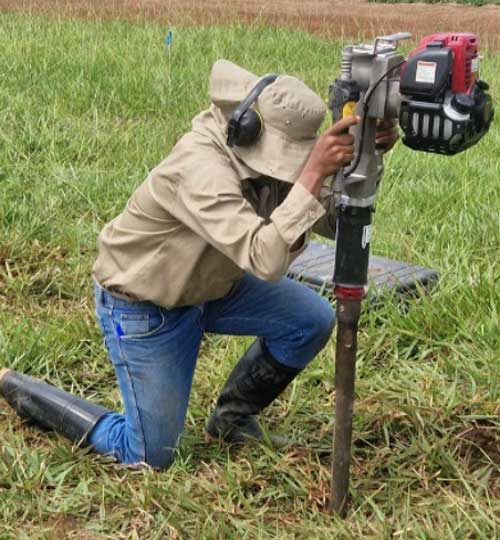
Soil science seeks to deepen our understanding of the thin yet vital layer of life-supporting material beneath our feet; a fundamental resource that is often overlooked. This field explores how soil forms, how it functions, and how it underpins food production and a wide range of ecosystem services, from filtering water to storing carbon and supporting more than half of Earth’s biodiversity.






Despite substantial progress, much of our current knowledge has been built from individual point samples, which are then extrapolated across broader areas such as fields or landscapes. This approach has generated valuable insights, but it has also left us with a picture that is highly detailed in some locations and far less certain in others.
Even some of the most important soil properties are rarely measured directly because doing so is difficult, time-consuming, or costly. Take soil carbon (C) as an example: soils are thought to store more carbon than the atmosphere and all living biomass combined, yet this estimate carries considerable uncertainty. Accurate carbon stock assessments require three pieces of information, only one of which is currently measured:
Topsoil volume, which depends not only on surface area but also on topsoil depth, which is often assumed to be 15–30 cm rather than measured;
Soil bulk density, the mass of soil within a given volume, which is frequently inferred from a limited number of samples or estimated from soil texture (the relative proportions of sand, silt, and clay).
Our approach can provide measurements of both 2 and 3, and in a spatially explicit manner, massively reducing the error associated with current soil carbon stock estimates.
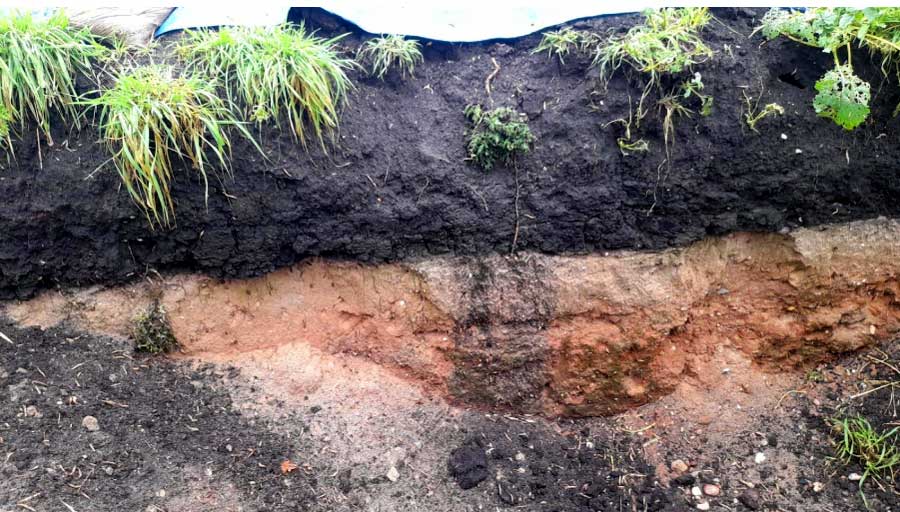
A soil profile showing a carbon rich topsoil on top of a carbon poor subsoil
Bulk density is closely linked to another key soil property: compaction. When soils are repeatedly driven over by farm machinery or trampled by livestock, the soil particles are pressed more tightly together. This reduces the spaces between them, limiting water infiltration, gas exchange between the soil and atmosphere, and root growth, all of which can negatively affect crop performance and yield. Compaction is especially problematic when it occurs below the surface, for example just beneath the tillage layer, because it can be difficult to detect and to remove.
Addressing deep compaction typically involves a process known as “subsoiling”. However, this remedy is expensive, energy-intensive requiring large amounts of diesel, and disruptive to the soil. Our approach enables users to identify where intervention is truly necessary, and at what depth subsoiling would be most effective. By targeting action only where it is needed, this technique can reduce costs, minimise environmental impact, and support more sustainable soil management.