One tap, many audiences: sharing the science beneath our feet

Marcelo Galdos
Research Technical Director
In the space of two months this autumn, the same simple action, a hammer tapping the ground, played out in front of very different people: children in London; Her Royal Highness The Princess Royal in Shropshire; the University of Exeter’s Vice-Chancellor; a farmer and his agronomist in a field in Dorset; and farmers, scientists and NGOs gathered in Limuru, Kenya. Each time, a screen lit up with wiggly lines. And each time, someone in the audience asked a version of the same question: so what does that tell you? Answering that question well, for each of them, has become one of the most rewarding parts of what we do at the Earth Rover Program.

The science is genuinely hard
We use ultra-high-frequency seismology to look inside soil without digging it up.
That sentence hides a great deal: wave physics, signal processing, inversion models, machine learning, and decades of soil science about how density, moisture and structure interact. Our papers are full of P-wave velocities and bulk density correlations. None of that is how you start a conversation with a child, a farmer in Dorset or Kenya, a royal visitor, or a university leader with a few minutes in a busy schedule.
But the core idea fits in one breath: tap the ground, measure how fast the vibration travels, and that speed tells you about the soil it passed through. Doctors use ultrasound to see inside the body without surgery; we use vibrations to see inside the soil without a spade.
What we have learned is that good science communication is not about inventing a different message for each audience. It is about keeping that one core message intact, and changing the conversation that follows it.
Before the soilbox: hammering in the field
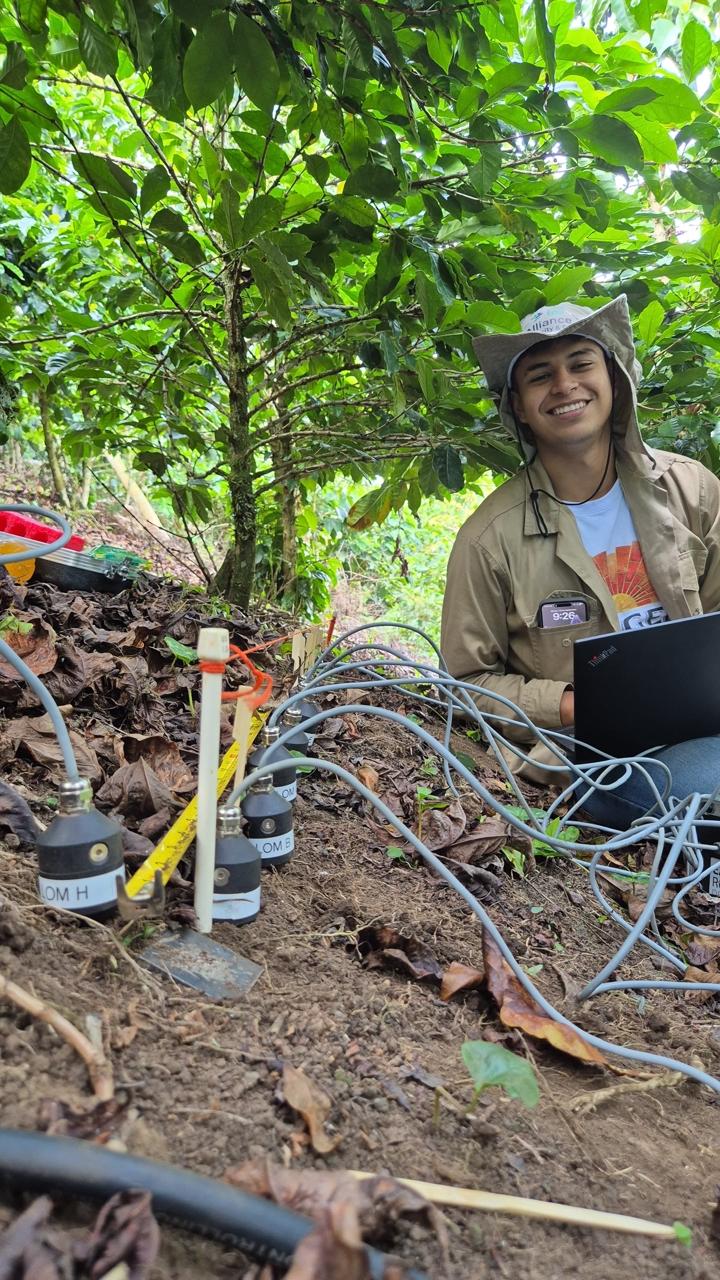
Since ERP began in 2023, most of our demonstrations have taken place where the research happens: in fields. A small hammer, a metal plate, a line of geophones, a laptop on a muddy tarpaulin. At our global launch in December 2025, we let the ground do the talking. Colleagues and partners in Australia, Colombia, Italy, Kenya and the UK picked up their hammers and struck the soil live, across four continents and some sixteen hours of time difference, while more than 700 people watched the waveforms appear on screen at our online event.
As Maure Figueroa, one of our researchers in Colombia, describes it, farmers expect to see augers and shovels, and instead find lines of sensors laid across the ground. The unfamiliar kit starts the conversation before anyone says a word.
Our soilbox arrived only this autumn: an orange cart with transparent sides displaying layers of topsoil over sand, a sensor, a bright red hammer and a screen showing the waveforms in real time. Its value is not novelty. It brings the field to people who may never stand in one, and it makes the invisible visible: you can see the layers that the waves are "seeing".

Our soilbox at Harper Adams University's 125th anniversary celebrations: the field, brought indoors.
Children: let them hit it
At New Scientist Live, on the Harper Adams University stand within the Farmers Weekly’s Future of Food and Agriculture exhibit, we invited visitors to generate their own seismic waves. The stand was hosted by our colleague Joe W. Collins, who has run many of our demonstrations. The strike plate had a target painted on it. By the end, it had been hit thousands of times and, as Joe put it, the stand only just survived.

Joe W. Collins with a young visitor at New Scientist Live, Excel London
With children, the explanation comes second. The tap comes first, then the lines on the screen jump, then the question: why did that happen? Only then are they ready to hear that a wave travels faster through squashed, compacted soil than through loose, crumbly soil. Joe was also interviewed for Farmers Weekly's #CuriousByNature series, which shows young people the careers behind feeding the world. That carries a second message underneath the first: soil scientists don't just wear white coats in laboratories.
Royalty and industry: the few-minutes version
ERP’s partner Harper Adams celebrated its 125th anniversary in September, and the Princess Royal, the university's Chancellor, visited our stand and had a go at generating seismic waves herself. Over the day, we demonstrated the kit to more than a hundred senior guests from across the agri-food sector.
Here the constraint is time. You get minutes, not an hour, so the discipline is to choose: one demonstration, one result that is already proven, and one sentence on why it matters. For us, that proven result is this: on long-term trial plots at Harper Adams, seismic wave speed closely matched soil density measured from cores, well enough to tell conservation and conventional tillage apart. It matters because dense, compacted soil holds back roots, water and yields, and has always been slow and costly to measure.
University leadership: from the box to the globe
Recently, Jiayao Meng and Tarje Nissen-Meyer took a similar demonstration to the University of Exeter’s faculty research showcase, for an audience including the Vice-Chancellor and members of the University’s Council. They designed it as a mini survey: council members took measurements themselves, using low-cost MEMS sensors (the same kind of tiny motion chip found in smartphones) and two smartphone apps built by ERP colleagues, and watched the same waves appear on different instruments. Then they zoomed out, connecting the wave speeds just measured in a box to our field hubs on three continents and our soil mapping work.
Feedback from this event singled out the interactive sessions. That does not surprise me. Whether the audience is seven or seventy, a royal or a university leader, people trust what they have done with their own hands.
Farmers in Dorset: the “so what?” audience
Farmers are perhaps the most demanding and most important audience, because they are not asking whether something is interesting. They are asking whether it is useful.
Through Agri-TechE’s Ambassador programme, Joe ran a field demonstration on a Dorset farm with agronomist Todd Jex and farmer David Lemon. Todd’s starting point was practical: two dry autumns had made the penetrometer (the standard way to check for compaction using a metal probe pushed into the ground) almost useless, and by the time the soil is moist enough to test, the crop is already in the ground. David’s question was sharper: what is the point of better information if weather or logistics stop you from acting on it?
That is exactly the right question. Joe’s answer was honest. The value is not a single snapshot but tracking soil over years, so that decisions become proactive rather than reactive. And he was clear that the Dorset recordings had not yet been fully analysed. Todd’s warning has stayed with me: the risk with new technology is fantastic science that a farmer picks up and finds simply will not work on-farm. The remedy is to bring farmers in early, as co-developers rather than end users.
Smallholders in Kenya: a different “so what?”
In September, our Kenya team and the Centre for Ecosystem Restoration Kenya (CER-K) hosted the UDONGO Soil Innovation Forum in Limuru, bringing together farmers, researchers, NGOs, donors and policy makers. Many in the room work alongside smallholder farmers every day, and they described a different starting point from Dorset. A smallholder farmer, very often a woman working a few acres, rarely starts with compaction. She wants to know which crop to grow, when to plant, and how much fertiliser is worth buying. The answers depend partly on soil structure, where seismic tools can help: compaction, hardpans, how water moves through the ground. They also depend on soil chemistry, which our tools alone cannot answer. Saying so plainly is part of the job.
So is how you say it. Kenya has dozens of languages, and soil science is usually written in only one of them, for readers with years of formal education. It is on us to bring useful information to farmers in a form that works, and that rarely means a report, a LinkedIn post or an exhibition stand. More often it means the people she already trusts: extension officers, farmer groups, and the organisations working alongside them. As one farmer delegate put it at the forum: “If a farmer, restoration practitioner or government officer cannot use that information to make a better decision, then we still have a gap between soil science and action.”

Agronomist Irene Odera demonstrates the hammer and sensors at the UDONGO Soil Innovation Forum in Limuru, Kenya
Media, social, and the machines
Beyond the rooms we are in, other people tell ERP’s story. Our launch last year has generated hundreds of media pieces and features, from BBC Science Focus to Pioneers Post, that have reached audiences we could never reach alone. One lesson: the word soilsmology (our blend of soil and seismology) travelled further than any explanation. A good name carries an idea. Another: our communications partners found that the launch framing was being cited by AI answer engines in hundreds of searches. That is a genuinely new audience, the systems that increasingly brief everyone else, and one more reason to choose our words carefully.
Some of our most creative communication comes from within the team. Maure, in Colombia, has made a “day in the life of an Earth Rover Program researcher” video in Spanish, Tik Tok-style with fast cuts, sound effects and plenty of humour. It shows what research papers leave out: the logistics, the mishaps, the thinking on your feet, and the camaraderie behind every dataset. And this reaches people who might never read a scientific paper or visit a research stand, in their own language and on their own platform.
Keeping the message, and keeping it honest
Across all of these, the core message stays the same. What changes is the starting point: a hammer for a child, a proven result for a royal visitor, a measurement taken with your own hands for a university leader, a hard “so what?” for a farmer in Dorset, a trusted voice in their own language for a smallholder in Kenya, a memorable word for a journalist, and a joke for someone scrolling.
There is one more thing that must not change: honesty about where the science is. Enthusiasm travels fast, and in the retelling, we are developing easily becomes we can. So we try to be clear about three things:
What we have shown: seeing inside soil without digging.
What we are building: richer soil maps, at scale.
What we are aiming for: soil insight in every farmer’s hands.
The vision matters: it is why people get excited and why partners join us. But trust, once lost, is very hard to win back. The best communication I have seen this autumn did both. It let people feel the thrill of seeing beneath their feet, and it told them truthfully how far we have come.
Over to you
Whether you farm, fund, teach, research, or are simply curious about what lies beneath your feet, we’d like to hear from you. Does this resonate with your own experience of complex science, whether explaining it or having it explained to you? Have you found the same, or something quite different?
#Soilsmology #SoilHealth #ScienceCommunication #Seismology #SustainableAgriculture #AgriTech